


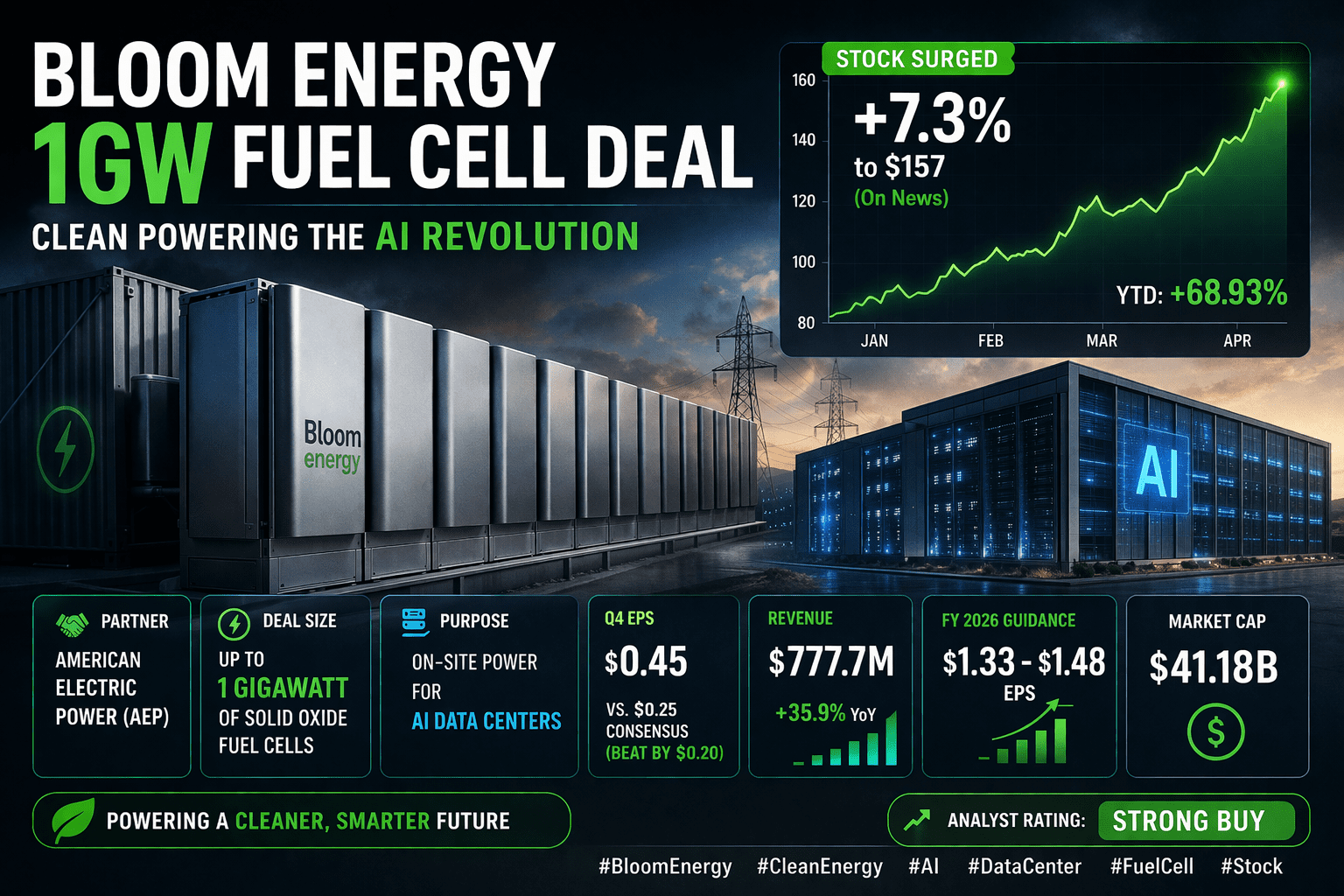
Bloom Energy has announced a landmark agreement with American Electric Power (AEP) to deploy up to 1 gigawatt of solid oxide fuel cells, sending its stock up 7.3% and reinforcing investor confidence in the company’s growth trajectory. Beyond the immediate market reaction, this deal highlights a deeper structural shift: the rapid convergence of artificial intelligence (AI) infrastructure and clean energy solutions.
1. A Landmark Deal in Scale and Strategic Positioning
The agreement to deliver up to 1GW of fuel cell capacity marks one of the largest deployments of its kind. Designed to provide on-site power for AI data centers, the deal reflects a growing demand for reliable, scalable, and low-emission energy sources.
Unlike traditional grid dependence, on-site fuel cell systems offer data centers greater control over energy supply, reducing exposure to grid constraints and volatility. For Bloom Energy, this positions its solid oxide fuel cell technology as a critical enabler of next-generation digital infrastructure.
2. Strong Financial Performance Reinforces Market Confidence
The announcement is supported by robust financial results. Bloom Energy reported Q4 earnings per share (EPS) of $0.45, significantly exceeding the consensus estimate of $0.25. Revenue reached $777.7 million, representing a 35.9% year-over-year increase.
Looking ahead, the company’s FY2026 guidance projects EPS in the range of $1.33 to $1.48, signaling continued growth. With a market capitalization of $41.18 billion and a year-to-date stock performance of nearly 69%, Bloom Energy is increasingly viewed by analysts as a “Strong Buy,” reflecting both operational strength and future potential.
3. AI Data Centers: The New Driver of Energy Demand
At the core of this development is the explosive growth of AI data centers. Training and deploying large-scale AI models require immense computational power, which translates directly into rising electricity demand.
Traditional energy infrastructure is struggling to keep pace, particularly in regions where grid capacity is constrained. As a result, data center operators are turning to alternative energy solutions that can deliver consistent, high-density power. Fuel cells -especially solid oxide variants – offer high efficiency, reliability, and the ability to operate continuously, making them well-suited for this use case.
4. Clean Energy Meets Digital Infrastructure
This deal underscores a broader trend: clean energy is no longer just about sustainability – it is becoming a strategic necessity for digital growth.
Fuel cells provide a lower-emission alternative to conventional fossil fuel-based generation while ensuring the uptime required by mission-critical facilities like data centers. In this context, technologies like Bloom Energy’s are not merely environmental solutions; they are infrastructure enablers for the AI economy.
5. Implications for the Energy and Investment Landscape
For the energy sector, the rise of AI-driven demand is accelerating investment in decentralized and innovative power solutions. Companies that can deliver scalable, reliable, and cleaner energy systems are likely to capture significant market share.
For investors, Bloom Energy’s performance illustrates how clean energy companies are benefiting from cross-industry tailwinds. The intersection of AI and energy is creating new growth narratives, where technological advancement and sustainability reinforce each other.
Conclusion
Bloom Energy’s 1GW fuel cell deal is more than a corporate milestone – it is a signal of transformation in both the energy and technology sectors. As AI data centers continue to expand, the need for reliable and sustainable power will only intensify. In this emerging landscape, clean energy solutions like fuel cells are poised to play a central role, bridging the gap between digital innovation and energy resilience.