



In the history of energy markets, it is rare to witness a period where short-term and long-term price expectations diverge as clearly as they do today. While consumers and businesses are enduring mounting price pressures month after month, long-term futures contracts are signaling a deep correction. This paradox is not ordinary noise — it is a structural signal.
1. Oil Prices: A Short-Term Spike and a Planned Decline
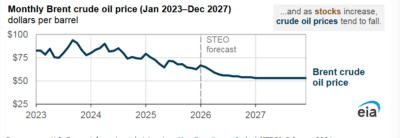
According to the March 2026 Short-Term Energy Outlook from the U.S. Energy Information Administration (EIA), Brent crude oil settled at $94 per barrel on March 9, 2026, and is expected to remain above $95 per barrel for at least the next two months. The direct cause is severe supply disruptions in the Middle East.
However, by late 2026, the picture changes completely. EIA forecasts show a clear downward trend, with Brent crude potentially falling to around $70 per barrel by the end of 2026. In 2027, Brent is expected to average $64 per barrel. The reasons include not only recovering supply but also broad-based signs of weakening industrial demand.
While spot oil prices are rising sharply, forward energy markets are already signaling a different story. In electricity markets, forward pricing shows a clear divergence: short-term contracts remain elevated, while longer-term contracts are trending downward. This pattern reflects a broader expectation across energy markets: volatility will persist in the near term, but structural pressures are not expected to sustain permanently high prices. In other words, the market is not pricing a prolonged energy supercycle — it is pricing instability.
2. The Unprecedented Crisis in the Middle East
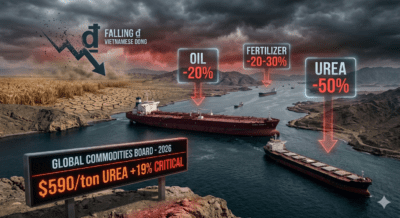
In mid-March 2026, a major escalation in the Strait of Hormuz — a chokepoint through which approximately 20% of global oil and 20–30% of global fertilizer pass, as well as nearly 50% of global urea and 20% of global LNG — pushed commodity markets into a state not seen in two decades.
In a rare joint statement issued in April 2026, three of the world’s leading institutions the World Bank, the International Monetary Fund (IMF), and the International Energy Agency (IEA) assessed this as one of the largest energy supply disruptions in history.
According to the International Food Policy Research Institute (IFPRI), the cascading consequences were immediate:
- Ship traffic through the Strait of Hormuz fell by more than 70% in a very short period.
- Middle East urea prices exceeded $590 per ton and rose by more than $90 in a single week, equivalent to an increase of roughly 19%.
- In Egypt, urea prices recorded an increase of up to 28%.
The Food and Agriculture Organization (FAO) of the United Nations has officially warned of a global food security risk as fertilizer prices spike and supply disruptions persist.
Three major systemic risks are now present:
- Food prices will face enormous pressure in the coming quarters, as fertilizer costs rise and main harvest seasons approach.
- Emerging market currencies, including the Vietnamese đồng, are under depreciation pressure due to surging import costs for energy and fertilizers.
- This is no longer purely an energy crisis it is a systemic crisis where prices, logistics, food security, and fiscal stability are tightly interlinked.
3. Where Do Vietnamese Manufacturing Enterprises Stand?
Most enterprises today still manage energy costs the traditional way: recording electricity, water, and compressed air readings at the end of the month, then aggregating and averaging them into a single cost figure. This method was already outdated, but in a context of week-to-week price volatility, it becomes dangerous.
When oil and gas prices fluctuate wildly, dragging electricity and production costs with them, a company without real-time monitoring will never know:
- Which machine is consuming abnormal amounts of electricity.
- Which hours of the day drive operating costs highest.
- When an air or water leak first appeared.
In a market where volatility is the new normal, manual management is like driving into a storm while only looking in the rearview mirror.
4. LC Tech and the MMM Solution: Technology at the Right Time
At LC Tech, we do one thing: help businesses see their energy costs minute by minute.
The MMM (Multi-Meter Machine) system from LC Tech is a solution that monitors electricity, water, compressed air, steam, oil, and gas on a single platform. MMM is designed to connect directly into existing electrical panels and pipelines, read data from analog or digital meters, and push that data to a dashboard within 15 minutes of installation.
What MMM delivers in today’s volatile energy environment:
- Leak detection in days, not months: In an actual case study at customer Stanley, the MMM system detected a leak of just 0.5 liters per minute in a pipeline. This timely detection saved the company 10.3 million VND per month.
- Significant reduction in electrical losses: At the Hanes factory, after deploying MMM, electrical loss rates fell from 18% to 3%, representing approximately 15% savings in electricity costs.
- Alert before the bill arrives: When energy prices spike due to market volatility, MMM tells you exactly which equipment is running during peak price hours, so you can adjust operating schedules immediately.
- Reduced reliance on manual recording: Every day that passes without an automated monitoring system is a day a business is losing money without knowing it.
Conclusion
The energy market of 2026 is unlike any period in the past decade. Data from the EIA, IFPRI, FAO, IMF, and IEA all point to a clear reality: oil prices will spike in the short term, but more worrying is the cascading effect on fertilizers, food, and the entire global economic system. Businesses that wait passively for prices to rise or fall before reacting are accepting risks that can be controlled. The question now is not “Will oil be $70 or $100 per barrel?” The right question is: Can you see where your money is flowing every single day? LC Tech is present in the Vietnamese market to solve that problem — no hype, no theory, only sensors, data, and real numbers from hundreds of completed case studies.