


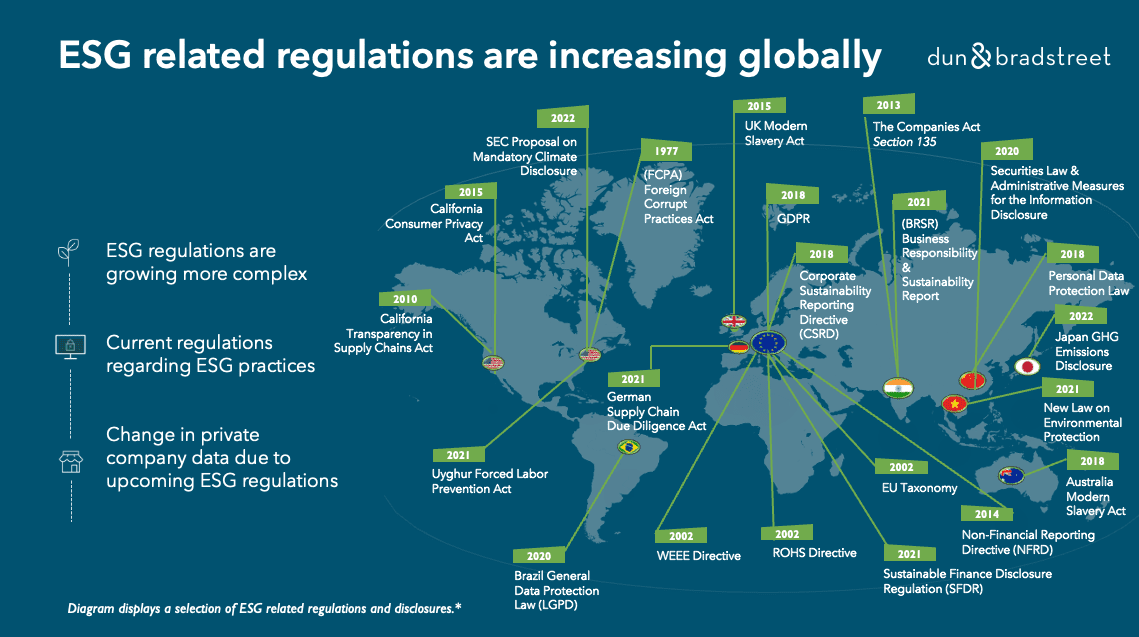
The doubling of ESG regulations within a single year is not an isolated regulatory phenomenon—it represents a systemic shift in how sustainability is governed, measured, and enforced across global markets.
This acceleration is fundamentally redefining ESG from a disclosure-based obligation into a continuous, data-intensive governance framework embedded within enterprise operations.
However, most organizations remain structurally unprepared, relying on legacy compliance architectures that cannot scale with the speed, complexity, and granularity of modern ESG requirements.
1. Regulatory Complexity Is Scaling Faster Than Organizational Capability
The current wave of ESG regulation is characterized by multidimensional expansion across jurisdictions, metrics, and reporting frequency.
Organizations are now required to manage:
- Cross-border regulatory alignment (EU, US, Asia frameworks)
- Scope 1, 2, and increasingly Scope 3 emissions tracking
- High-frequency disclosure cycles (quarterly → real-time expectations)
- Audit-ready, verifiable data pipelines
This creates a structural asymmetry: regulatory systems are evolving exponentially, while organizational compliance capabilities are improving linearly.
The result is a widening compliance gap that cannot be closed through incremental process improvements.
2. The Collapse of Periodic Reporting: ESG Becomes Continuous
Traditional ESG reporting models are based on periodic aggregation—quarterly or annual snapshots of performance.
This model is becoming obsolete. Modern ESG frameworks increasingly require:
- Continuous monitoring of operational data
- Real-time validation and traceability
- Immediate anomaly detection (e.g., emissions spikes, energy inefficiencies)
This transforms ESG into a real-time system rather than a retrospective reporting function. Organizations must shift from “reporting what happened” to “monitoring what is happening.”
3. GenAI as the Orchestration Layer of ESG Intelligence
Generative AI is not merely an automation tool—it is emerging as the orchestration layer that integrates, interprets, and communicates ESG data at scale.
Its role spans multiple dimensions:
- Data integration: Aggregating structured and unstructured ESG data across systems
- Interpretation: Translating raw metrics into actionable insights
- Communication: Generating stakeholder-ready reports in natural language
- Scenario modeling: Simulating ESG outcomes under different operational conditions
This effectively transforms ESG from a fragmented data problem into a unified intelligence system.
4. Predictive ESG: From Compliance to Forward-Looking Strategy
The integration of AI enables a transition from descriptive analytics to predictive and prescriptive ESG management.
Organizations can now:
- Forecast emissions trajectories under different growth scenarios
- Identify future compliance risks before they materialize
- Optimize energy usage and resource allocation dynamically
- Align operational decisions with long-term sustainability targets
This redefines ESG as a forward-looking strategic capability rather than a backward-looking reporting obligation.
5. Data Architecture Becomes the Core Constraint
As ESG systems scale, the primary bottleneck is no longer technology availability, but data architecture. Key challenges include:
- Data fragmentation across departments and systems
- Lack of standardization in ESG metrics
- Inconsistent data quality and validation processes
- Integration of IoT, enterprise systems, and external data sources
Without a unified data architecture, even advanced AI systems cannot deliver reliable ESG insights.
6. Financialization of ESG: Capital Markets Are Repricing Transparency
ESG is increasingly embedded into financial decision-making. Investors are moving beyond qualitative ESG narratives toward quantitative, verifiable metrics.
This leads to:
- Capital allocation favoring companies with transparent ESG data
- Lower cost of capital for high-performing ESG organizations
- Increased scrutiny and risk premium for opaque or inconsistent reporting
In this context, ESG data quality becomes a financial asset.
7. Organizational Transformation: ESG as an Operating System
The convergence of regulation, AI, and data is transforming ESG into an enterprise-wide operating system. It is no longer a siloed function but an integrated layer across:
- Operations (energy, resource efficiency)
- Supply chains (Scope 3 visibility)
- Finance (risk, capital allocation)
- Strategy (long-term positioning)
This integration enables organizations to align compliance, efficiency, and value creation.
8. Competitive Dynamics: Early Movers vs Structural Laggards
A divergence is emerging between organizations that adopt real-time, AI-driven ESG systems and those that remain dependent on legacy processes.
Early adopters benefit from:
- Automated compliance at scale
- Superior data transparency
- Faster decision-making cycles
- Stronger investor confidence
Laggards face compounding disadvantages, including higher compliance costs and increased regulatory exposure.
9. Long-Term Outlook: ESG Intelligence as a Core Capability
The trajectory of ESG suggests that it will evolve into a core intelligence capability within enterprises, similar to financial systems or ERP platforms.
Organizations that treat ESG as a strategic system—not a compliance burden—will define the next generation of market leaders. The transition is not optional. It is structural, irreversible, and accelerating.