


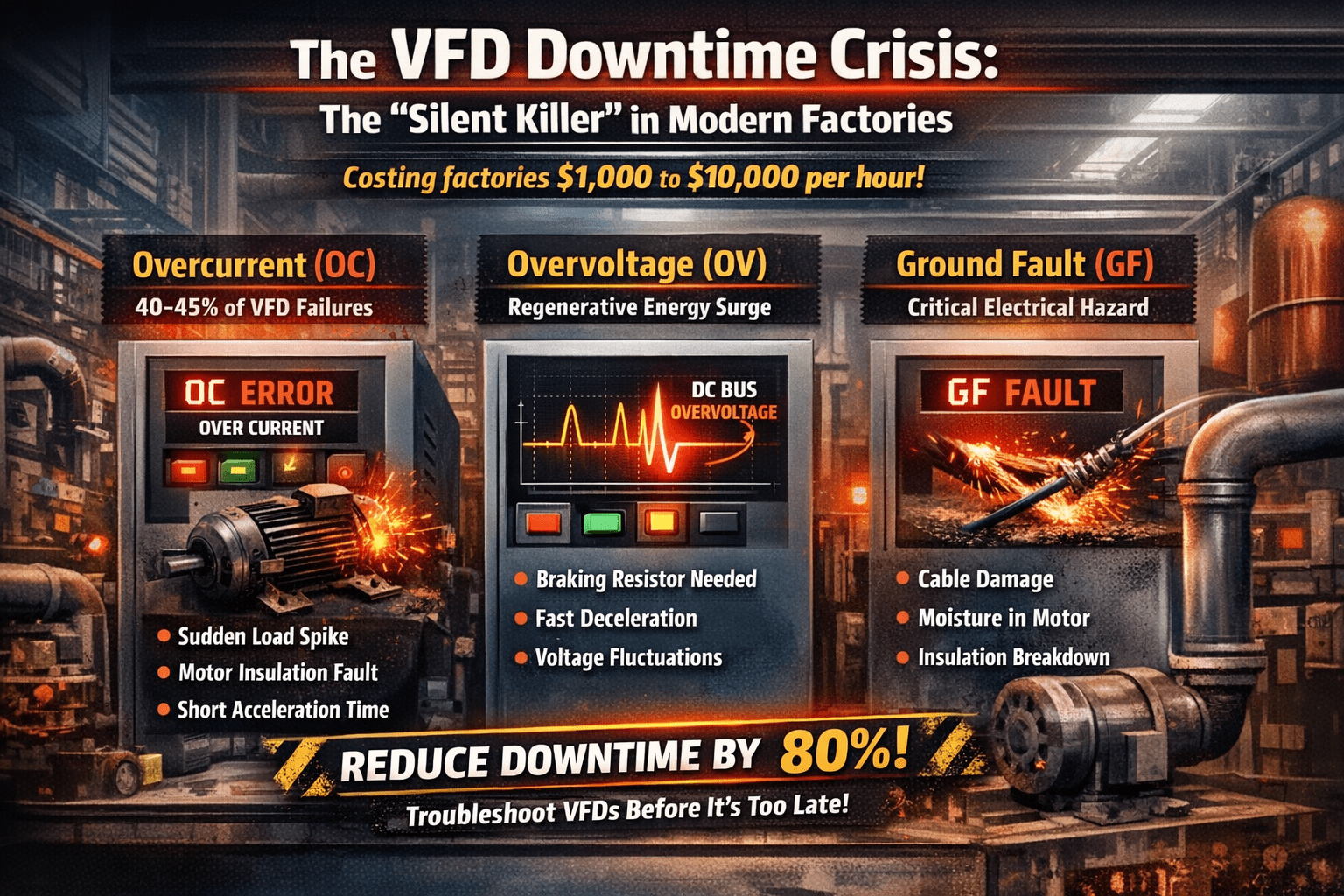
Every hour a production line stops, factories lose between $1,000 and $10,000. Often, the culprit is a seemingly minor Variable Frequency Drive (VFD) trip. While VFDs are essential for energy savings and motor control, when they fail, they cause massive operational headaches.
Real-world data shows that just three faults – Overcurrent (OC), Overvoltage (OV), and Ground Fault (GF) – account for 70-80% of unplanned downtime. Knowing how to diagnose them is the difference between a 5-minute fix and a 5-hour shutdown.
1. Overcurrent (OC): The Most Common Culprit
Accounting for 40-45% of all VFD failures, an OC fault triggers when the output current exceeds safe limits (usually 150-200% of the rated current).
-
Root Causes: Sudden mechanical jams (e.g., seized bearings), degraded motor/cable insulation, or an acceleration time that is set too short for high-inertia loads.
-
The Fix:
+ The Isolation Test: Disconnect the motor and run the VFD empty. If the fault clears, the problem lies in the motor or the mechanical load. If it still trips, the VFD hardware is damaged.
+ Parameter Tweak: Increase the acceleration time (10 – 20 seconds) or use an S-curve to prevent massive starting current surges.
+ Megger Test: Check motor and cable insulation (must be > 2MΩ).
2. Overvoltage (OV): The Regenerative “Assassin”
Contrary to popular belief, OV faults rarely come from a bad power grid. They are almost always caused by the motor’s own regenerative energy.
-
Root Causes: When a fast-moving motor is told to brake abruptly, its kinetic energy acts like a generator, pumping electricity back into the VFD. If the VFD cannot dissipate this energy, the internal DC bus voltage spikes, causing a trip.
-
The Fix:
+ Extend Deceleration Time: Increase the stopping time (e.g., from 2s to 15s) to allow the energy to dissipate naturally.
+ Install a Braking Resistor: For high-inertia applications (centrifuges, cranes), this is mandatory to burn off excess energy as heat.
+ Check the Grid (If random): If OV happens without a stop command, install an input line reactor to stabilize grid fluctuations.
3. Ground Fault (GF): The Safety Hazard
A GF fault stops production and signals a severe electrical safety risk. It means the current has found a shortcut to the ground (machine frame or chassis).
-
Root Causes: Chewed or damaged power cables, high-moisture environments, or shorted motor windings due to overheating.
-
The Fix:
+ Golden Safety Rule: Lock-Out/Tag-Out (LOTO) first. Never use a Megger while cables are still connected to the VFD—the high test voltage will instantly destroy the VFD’s internal circuitry.
+ Disconnect & Test: Completely detach the phase wires from the VFD. Use a Megger to test the cables and motor directly to the ground. A reading in the KΩ range or 0Ω confirms a dead short.
Conclusion: Stop Guessing, Start Logging
A VFD doesn’t fail randomly; it sends warning signals. By recording exact fault codes before resetting, keeping cooling fans and boards clean, and having the right diagnostic tools on hand, engineers can shift from reactive panic to predictive maintenance. Protecting your VFDs isn’t just a technical task—it’s a core strategy for protecting factory profitability.
Which VFD fault causes the most headaches in your facility? Let’s discuss in the comments below!